
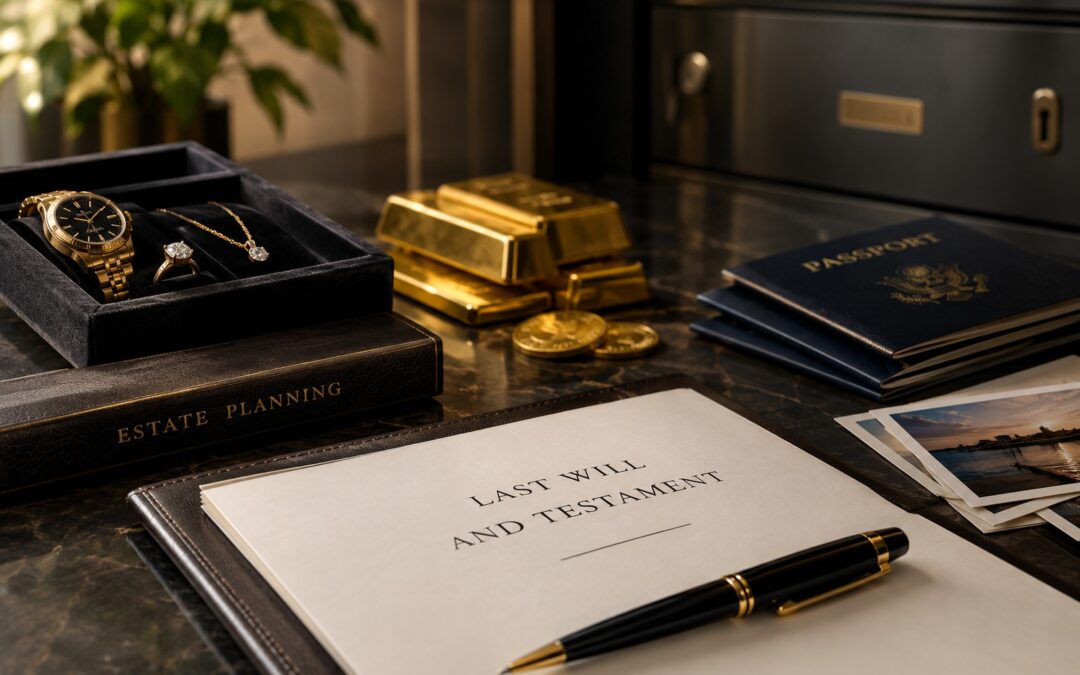
Estate planning is about more than writing a Will. It is also about making sure the people you trust can find, identify and ultimately deal with the things you leave behind.
For many Australians, the most valuable things they own are not sitting in one obvious place.
Gold and silver bullion may be stored separately from jewellery. Important documents might be in a filing cabinet. Family heirlooms could be kept in a safe. Digital records may exist across computers, hard drives and cloud accounts.
And sometimes, the people closest to you may not know exactly what you own, or where it is kept.
This can become particularly important when an estate contains valuable jewellery, precious metals, watches, collectibles, important documents or other assets that are stored securely outside the home.
A well-organised estate plan should therefore answer two questions:
Who should receive my valuables?
And perhaps just as importantly:
How will they know where those valuables are and how to access them?
Important: This article provides general information only and is not legal, financial or estate-planning advice. Estate and succession laws can be complex. If you are preparing or updating your estate plan, speak with a qualified legal professional.
Your Will Is Only Part of the Picture
A Will is an important part of an estate plan. In Queensland, a Will sets out how your assets are to be distributed and can identify beneficiaries, personal or family items you want particular people to receive, and the person or organisation you appoint as executor.
If someone dies without a Will, they are considered to have died intestate, and the estate is distributed according to Queensland’s intestacy laws rather than according to the person’s own instructions.
For anyone with significant assets, however, simply having a Will is not necessarily the end of the planning process.
Imagine, for example, that your Will says:
“I leave my gold and jewellery to my children.”
That may establish your wishes, but does your executor know:
- How much bullion you own?
- Where it is stored?
- Which jewellery pieces are valuable?
- Where the relevant purchase records or valuations are kept?
- Which items have sentimental rather than financial value?
- Whether any valuables are held outside your home?
- Which storage facility holds them?
- How the executor can begin the process of dealing with those assets?
The more complicated your financial and personal affairs become, the more important this information can be.
The Role of the Executor
An executor is responsible for administering your estate in accordance with your Will.
This can involve locating the Will, identifying and protecting assets, notifying beneficiaries, dealing with liabilities, collecting valuables and ultimately distributing assets according to the estate.
For someone with a straightforward estate, this may be relatively simple.
For someone who has accumulated precious metals, jewellery, watches, collectibles, property, investments and important documents over many years, it can be considerably more involved.
This is why an estate plan should not only tell your executor what you want to happen. It should also make it easier for them to understand what you own and where to find it.
Create a Valuables Inventory
One of the simplest things you can do is create a private inventory of your significant possessions.
This doesn’t necessarily need to be attached to your Will. In fact, because your assets can change over time, maintaining a separate inventory that can be updated may be more practical.
Depending on your circumstances, it could include:
Precious Metals
- Gold bullion
- Silver bullion
- Platinum bullion
- Rare or collectible coins
- Purchase records
- Current valuations
Jewellery & Watches
- Engagement and wedding rings
- Family heirlooms
- Fine jewellery
- Luxury watches
- Certificates and valuations
- Receipts or provenance
Important Documents
- Property documents
- Trust documents
- Company records
- Insurance documentation
- Collectible certificates
- Other important legal or financial records
Sentimental Items
Don’t overlook things that may have little monetary value but enormous personal significance.
Family photographs, letters, medals, heirlooms and other keepsakes may be among the things your family most wants to preserve.
Private Vaults Australia has previously discussed the importance of protecting items that cannot simply be replaced. A secure storage facility can be useful for both financially valuable assets and irreplaceable personal possessions.
Make Sure Someone Knows Where Your Valuables Are
There is an important balance to strike here.
You don’t necessarily want a detailed list of everything you own sitting somewhere that is easily accessible to anyone.
But your executor or another trusted person should be able to establish where important assets are held when they need to.
This is particularly relevant when valuables are held outside your home.
For example, if you have a safety deposit box containing jewellery, bullion, important documents or family heirlooms, your family may not know it exists unless you have made appropriate arrangements.
The solution isn’t necessarily to give someone unrestricted access during your lifetime.
Instead, consider documenting:
What is stored → Where it is stored → Who should deal with it → What documents they may need.
The exact arrangements for accessing a storage facility after someone’s death will depend on the provider’s terms and the legal authority of the executor or administrator. It is therefore worth discussing your arrangements with the facility and your legal adviser when preparing your estate plan.
At Private Vaults Australia, safety deposit boxes are designed so that the client retains control of their own box and access. This makes it particularly important that customers consider how their estate arrangements will work in the future.
Don’t Forget the Important Documents
Sometimes the most important assets in an estate aren’t the most valuable ones.
A lost original document can create unnecessary complications when a family is already dealing with the loss of someone close to them.
Depending on your circumstances, important documents may include:
- Your original Will
- Trust deeds
- Property documentation
- Insurance records
- Company documents
- Important certificates
- Financial records
- Collectible documentation
- Copies or records relating to valuable possessions
The key is not simply storing these documents securely.
It is making sure the appropriate people know that they exist and where they are located.
Queensland’s Public Trustee notes that locating the Will is one of the first steps involved in administering a deceased estate.
If an important document is securely stored but nobody knows where it is, its security can ironically become an obstacle.
What About Gold, Silver and Other Precious Metals?
Precious metals deserve particular consideration because they can be accumulated gradually over many years.
A person might purchase a few gold coins one year, silver bars the next, and eventually build a substantial collection.
Over time, it can become surprisingly difficult for someone else to establish exactly what is owned.
If you hold bullion, consider maintaining a record of:
- Type of metal
- Number of pieces
- Weight
- Manufacturer or mint
- Serial numbers where applicable
- Purchase documentation
- Storage location
- Relevant insurance information
- Any valuation or inventory records
This information can make it considerably easier for an executor to identify and account for the assets of an estate.
For larger holdings, professional bullion storage can also provide a centralised location for assets.
Private Vaults Australia offers dedicated bullion storage options alongside safety deposit boxes, allowing customers to store precious metals securely away from the home.
Consider Who Needs to Know
Estate planning involves more than simply choosing beneficiaries.
You should also think carefully about who needs to know about your arrangements.
Depending on your circumstances, this could include:
Your executor
The person responsible for administering your estate needs enough information to locate and identify your assets.
Your solicitor or estate-planning professional
They can help ensure your Will and broader estate arrangements reflect your intentions.
Your partner or immediate family
They may need to know where critical documents or important assets are located.
Your accountant or financial adviser
Where appropriate, they may need information about assets and financial structures forming part of your broader estate plan.
You don’t necessarily need to tell everyone everything.
The objective is simply to prevent a situation where an important asset effectively disappears from view because nobody knows it exists.
Review Your Estate Plan When Your Life Changes
An estate plan shouldn’t be something you create once and put away forever.
Your circumstances can change considerably over the course of a few years.
For example:
- You purchase a property
- Your family changes
- A beneficiary passes away
- You acquire significant jewellery or bullion
- You establish a trust or company
- You retire
- Your financial circumstances change
- You move interstate or overseas
- An executor is no longer able or willing to act
Queensland Government guidance recommends reviewing a Will every 3 to 5 years, while also updating it when significant life circumstances change.
Your valuables inventory should be reviewed even more regularly if your assets are changing.
A Will that accurately reflects your wishes is important.
An up-to-date record of your assets and their locations is what can help make those wishes practical to carry out.
A Simple Estate Planning Checklist for Your Valuables
If you have accumulated valuable or irreplaceable possessions, consider working through the following checklist.
1. Have you made a current Will?
If not, consider speaking with a qualified legal professional.
2. Have you chosen an executor?
Make sure the person you nominate understands the responsibility involved and is willing to take it on.
3. Have you listed your significant valuables?
Include bullion, jewellery, watches, collectibles, heirlooms and other important possessions.
4. Do you know where your important documents are?
Make sure originals and important records are securely stored.
5. Does your executor know where to find the information?
They don’t necessarily need unrestricted access to your valuables now — but they should know where the relevant information can be found when required.
6. Have you documented your storage arrangements?
If you use a safety deposit box, bullion locker or other secure facility, make sure your estate plan accounts for it.
7. Are your records up to date?
Review your inventory when you acquire, sell or transfer significant assets.
8. Have you reviewed your Will recently?
Major changes in your family, finances or assets may warrant a review.
Secure Storage Is Part of the Bigger Picture
Estate planning and secure storage are sometimes treated as completely separate issues.
In reality, they can work together.
A Will determines who should receive your assets.
An inventory helps establish what those assets are.
Good record-keeping helps establish where they are located.
And secure storage helps protect those assets until they can be dealt with appropriately.
For people who hold significant amounts of bullion, jewellery, important documents, watches or family heirlooms, this can form an important part of a broader approach to protecting what they have accumulated.
At Private Vaults Australia, our Redcliffe facility provides secure storage options for valuables including bullion, jewellery, important documents and family heirlooms. Our safety deposit boxes are located within a privately operated, independently monitored vault facility, providing customers with a secure location away from the risks associated with keeping valuable possessions at home.
The goal isn’t simply to protect your valuables today.
It’s to make sure that when the time comes, the people you trust can deal with them properly.
Protect What You’ve Worked to Accumulate
For many people, wealth and valuables are accumulated over decades.
Gold purchased over many years. Jewellery passed down through generations. Important documents that cannot easily be replaced. Family possessions carrying memories that are worth far more than their monetary value.
Protecting these things is one part of the equation.
Making sure your family knows how to find them is another.
Thoughtful estate planning considers both.
If you are reviewing your estate arrangements, consider speaking with your solicitor or qualified estate-planning professional about your individual circumstances and how your valuables and secure storage arrangements should be incorporated into your plan.


2 months free. No long-term commitment necessary. Limited spots available.

Recent Comments