
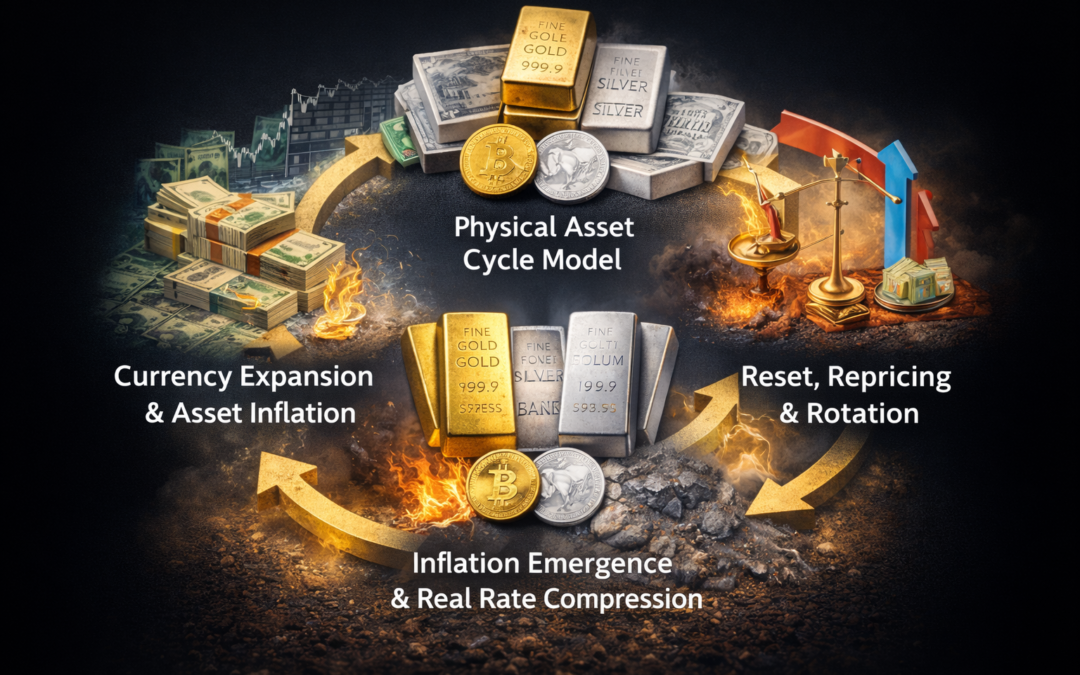
The Physical Asset Cycle Model
How Gold, Silver & Platinum Move Through Cycles — and How Sophisticated Investors Position Ahead of Them
Most investors are taught to think about assets.
Sophisticated investors think about cycles.
Markets do not move randomly.
They move in repeatable, identifiable phases driven by liquidity, confidence, debt, inflation, and systemic stress.
Yet most portfolios are constructed as if:
- markets rise smoothly,
- correlations remain stable,
- and liquidity is always available.
History proves otherwise.
This is where the Physical Asset Cycle Model becomes essential — particularly for SMSF trustees, high-net-worth individuals, family offices, and business owners who care less about quarterly noise and more about long-term capital survival and real purchasing power.
This article explains:
- how physical assets move through predictable cycles,
- why precious metals behave differently from paper assets,
- how gold, silver and platinum rotate leadership,
- and how informed investors position before cycles become obvious.
This is not speculation.
It is structural capital management.
Why Asset Cycles Matter More Than Asset Selection
Most investors ask:
“Which asset should I buy?”
The better question is:
“Where are we in the cycle — and which assets benefit next?”
Every major asset class moves through cycles influenced by:
- monetary policy,
- credit expansion and contraction,
- inflation and deflation,
- confidence in institutions,
- and access to liquidity.
Paper assets (shares, bonds, ETFs, property) are cycle-dependent on the financial system.
Physical assets — particularly precious metals — operate on a different cycle altogether.
They respond not to growth narratives, but to:
- currency debasement,
- loss of trust,
- negative real interest rates,
- and systemic fragility.
Understanding this difference is the foundation of resilient portfolio construction.
The Core Difference: Paper Asset Cycles vs Physical Asset Cycles
Paper Asset Cycles
Paper assets thrive when:
- credit is expanding,
- confidence is high,
- leverage is rewarded,
- liquidity is abundant,
- and counterparty risk is ignored.
They suffer when:
- credit tightens,
- inflation erodes real returns,
- leverage unwinds,
- liquidity freezes,
- or institutions fail.
Physical Asset Cycles
Physical assets thrive when:
- currencies lose purchasing power,
- debt becomes unserviceable,
- trust in institutions weakens,
- inflation persists,
- and real interest rates turn negative.
They are not dependent on:
- earnings growth,
- financial engineering,
- central bank credibility,
- or continuous market access.
This is why physical assets behave as cycle insurance, not growth speculation.
The Four Phases of the Physical Asset Cycle
The Physical Asset Cycle typically unfolds in four repeating phases:
Phase 1 — Currency Expansion & Asset Inflation
Environment
- Low interest rates
- Quantitative easing
- Expanding money supply
- Rising asset prices
- Compressed volatility
Investor Behaviour
- Preference for equities and property
- Precious metals under-owned
- Gold seen as “boring” or unnecessary
What Smart Investors Do
- Begin quiet accumulation of physical metals
- Focus on ownership, not performance
- Prepare before confidence breaks
Phase 2 — Inflation Emergence & Real Rate Compression
Environment
- Inflation becomes persistent
- Interest rates lag inflation
- Real yields turn negative
- Cost of living rises faster than wages
Investor Behaviour
- Confusion
- Bond losses surprise investors
- “Diversification” fails
Metal Behaviour
- Gold begins to outperform cash and bonds
- Silver starts attracting attention
- Physical premiums rise
This is where physical assets re-enter relevance.
Phase 3 — Confidence Fracture & System Stress
Environment
- Banking stress
- Credit contraction
- Liquidity events
- Policy uncertainty
- Institutional credibility questioned
Investor Behaviour
- Rush toward safety
- Liquidity over returns
- Counterparty risk becomes visible
Metal Behaviour
- Gold becomes the primary monetary hedge
- Silver accelerates as both monetary and industrial demand converge
- Platinum begins re-rating from extreme undervaluation
This is the core outperformance phase for physical metals.
Phase 4 — Reset, Repricing & Rotation
Environment
- Policy reset
- Currency adjustments
- Debt restructuring
- New monetary frameworks
Investor Behaviour
- Rebuilding confidence
- Re-risking begins
- Capital rotates again
Metal Behaviour
- Gold stabilises after protecting purchasing power
- Silver and platinum may continue outperforming as industrial demand persists
- Opportunity arises to rebalance rather than exit
This phase rewards disciplined reallocation, not emotional selling.

Gold, Silver & Platinum
Gold, Silver & Platinum: Different Roles Within the Cycle
Gold — The Monetary Anchor
Gold performs best when:
- real rates are negative,
- currencies weaken,
- debt becomes unmanageable,
- and confidence erodes.
Gold does not chase growth.
It preserves purchasing power across cycles.
Silver — The Accelerator
Silver benefits from:
- monetary demand and
- industrial demand.
It often:
- lags gold initially,
- then outperforms dramatically during mid-cycle stress,
- particularly when inflation and electrification trends converge.
Platinum — The Deep Value Rotation
Platinum historically:
- becomes severely undervalued late in credit cycles,
- then re-prices rapidly when industrial demand resurfaces.
Hydrogen, emissions regulation and industrial catalysts make platinum a cycle-rotation asset, not a static hedge.
Why Most Investors Miss the Physical Asset Cycle
Because the cycle:
- does not show up in quarterly statements,
- is not promoted by financial platforms,
- does not generate recurring advisory fees,
- and cannot be “managed” like paper assets.
Financial planners are trained in:
- products,
- platforms,
- performance charts.
They are not trained in:
- monetary history,
- currency failure,
- physical asset behaviour,
- or non-financial-system assets.
SMSF trustees and sophisticated investors who study cycles — rather than headlines — see the opportunity early.
Ownership and Storage Complete the Cycle Strategy
A physical asset cycle strategy fails if:
- assets are unallocated,
- stored in banks,
- pooled,
- or dependent on counterparties.
True cycle resilience requires:
- physical ownership
- independent storage
- clear title
- exclusive access
This is why investors integrate:
- purchase through Gold Bullion Australia
- secure custody with Private Vaults Australia
Storage outside the banking system ensures:
- no bail-in exposure,
- no access freezes,
- no balance-sheet entanglement,
- and full auditability for SMSFs.
The Physical Asset Cycle Model in Practice
Sophisticated investors do not:
- chase tops,
- panic at corrections,
- or liquidate protection assets prematurely.
They:
- accumulate quietly during complacency,
- hold through volatility,
- rebalance during overvaluation,
- and retain physical ownership throughout.
This discipline transforms metals from “insurance” into a strategic portfolio pillar.
Conclusion: Cycles Reward Preparation — Not Prediction
The Physical Asset Cycle Model is not about timing markets perfectly.
It is about understanding:
- where we are structurally,
- how monetary systems behave under stress,
- and which assets survive when confidence fails.
Gold, silver and platinum have endured:
- inflation,
- wars,
- banking failures,
- currency resets,
- and systemic collapses.
They are not speculative assets.
They are cycle survivors.
For SMSFs, business owners and families building intergenerational wealth, understanding — and respecting — the physical asset cycle is no longer optional.
It is essential.
📞 1300 888 782
📍 Unit 3 – 73 Redcliffe Parade, Redcliffe
🔐 Store Physical Assets Independently
💰 Acquire Investment-Grade Bullion


2 months free. No long-term commitment necessary. Limited spots available.
