
Crypto Isn’t the Risk, Storage Is. Learn about Crypto Storage Security
Why Serious Digital Asset Holders Are Moving Their Keys Into Private Vaults for true Crypto Storage Security.
Most crypto investors believe the risk lies in price volatility.
Others worry about regulation, exchanges, or market cycles.
But the greatest risk to crypto holders today is none of these.
The real vulnerability is how — and where — private keys, seed phrases, and hardware wallets are stored.
Because while blockchain networks are decentralised, resilient, and mathematically secure…
your access to them is still physical.
And physical storage is where most crypto strategies quietly fail.
This article explains:
- why crypto itself is not the weak link,
- why home storage exposes digital wealth to real-world failure,
- how historical solar events threaten unprotected electronics,
- and why private vault storage — combined with Faraday protection — has become the gold standard for serious crypto holders wanting to learn about Crypto Storage Security.
This is not fear-based.
It is systems thinking.
Crypto Networks Are Resilient — Humans Are Not
Bitcoin, Ethereum, and decentralised ledgers are designed to survive:
- market crashes,
- nation-state interference,
- exchange collapses,
- censorship attempts,
- monetary debasement.
But private keys are still controlled by people.
And people:
- misplace things,
- suffer burglaries,
- experience fires and floods,
- get hacked socially,
- forget passwords,
- die unexpectedly.
Crypto doesn’t fail.
Key management does.
This is why long-term crypto holders don’t ask:
“Is my coin safe?”
They ask:
“Is my access safe under all conditions?”
The Carrington Event: A Risk Most Crypto Holders Have Never Considered
In 1859, the Carrington Event — the most powerful solar storm in recorded history — struck Earth.
The result:
- global telegraph systems failed,
- equipment caught fire,
- electrical infrastructure collapsed,
- operators received electric shocks,
- communications were disabled worldwide.
That was with 19th-century technology.
Today, a similar solar event would threaten:
- power grids,
- satellites,
- internet infrastructure,
- mobile networks,
- data centres,
- unshielded electronic devices.
Modern systems are far more vulnerable, not less.
This is not speculation.
NASA, space agencies, and defence departments openly acknowledge this risk.
Crypto networks would survive.
But unprotected hardware wallets, USB drives, and seed backups may not.
That’s why serious digital asset holders plan for electromagnetic disruption, not just cyber threats.
Why Home Storage Is the Weakest Link in Crypto Security
Most crypto losses don’t happen
…not on the blockchain.
They happen at home.
Most long-term crypto losses occur because:
- seed phrases were stored in a drawer,
- hardware wallets were kept in a bedside table,
- backups were on a laptop destroyed by fire or flood,
- devices were stolen during a break-in,
- paper backups degraded, faded, or were thrown out accidentally,
- family members couldn’t locate keys during illness or death.
Home storage concentrates every risk in one physical location:
- theft
- fire
- flood
- EMP / solar event exposure
- insurance denial
- loss of proof
- zero redundancy
Even a home safe does not solve this:
- safes are frequently stolen whole,
- most are not flood-rated,
- fire ratings do not protect electronics,
- insurers still apply crypto exclusions.
For a decentralised asset, home storage is ironically centralised risk.
Exchanges, Custodians & “Trusted Platforms” Are Not Sovereignty
Many crypto holders move off exchanges — correctly — but then replace one risk with another.
Third-party custodians introduce:
- counterparty exposure,
- access freezes,
- jurisdictional risk,
- compliance-driven lockouts,
- platform insolvency,
- withdrawal suspensions during stress events.
History is very clear on this:
- platforms fail,
- rules change,
- access disappears when it is needed most.
Self-custody is essential —
but self-custody without resilient physical storage is incomplete custody.
The Missing Layer: Offline, Shielded, Independent Storage
This is where elite crypto storage strategies diverge from retail thinking.
Sophisticated holders separate their security into three distinct layers:
Layer 1 — Digital Security
- strong passphrases
- hardware wallets
- multisig where appropriate
- no exchange exposure
Layer 2 — Physical Independence
- assets stored outside the home
- no reliance on domestic infrastructure
- no single-point-of-failure location
Layer 3 — Electromagnetic Protection
- Faraday-shielded storage
- protection from EMP, solar storms, and surge events
- air-gapped resilience
This is where private vault storage + Faraday protection becomes essential.
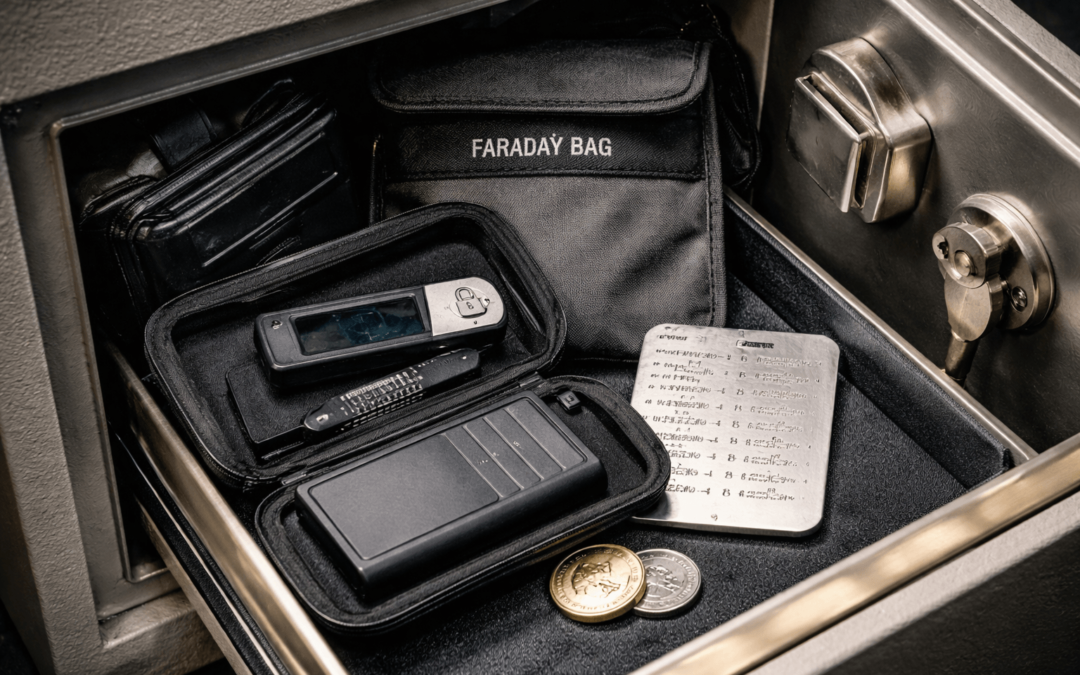
Why Faraday Bags Matter for Crypto Storage
A Faraday bag (also known as a Go Dark bag) blocks:
- electromagnetic interference (EMI),
- radio frequency signals (RF),
- static discharge,
- solar-induced surges,
- wireless access attempts.
When used correctly, they:
- isolate hardware wallets completely,
- protect against EMP-style events,
- prevent remote access or scanning,
- preserve device integrity long-term.
For crypto holders, this means:
- hardware wallets remain intact even during grid disruption,
- USB backups are shielded,
- seed phrase devices are preserved,
- air-gapped status is genuinely maintained.
When a Faraday bag is stored inside a private vault, the protection becomes layered, not theoretical.
Why Private Vaults Australia Is Built for Digital Asset Sovereignty
Private Vaults Australia is not a bank.
It is not a custodian.
It does not know what you store.
It provides infrastructure, not control.
For crypto holders, this means:
- non-bank independence,
- no reporting on contents,
- no platform exposure,
- no counterparty risk,
- exclusive keyholder access,
- flood-free, hardened construction,
- insured storage environment,
- private access rooms,
- no staff access to your assets.
Crypto keys stored this way are:
- offline,
- shielded,
- decentralised,
- sovereign,
- resilient under extreme conditions.
This is why serious holders — including business owners, SMSF trustees, and long-term crypto investors — quietly move their keys out of homes and into private vaults.
Crypto Is Digital — But Access Is Physical
This is the truth most people miss.
Crypto lives on the blockchain.
But your access lives in the physical world.
If you lose:
- your keys,
- your backups,
- your hardware,
- your documentation,
…the blockchain does not care.
It will not restore access.
It will not recognise intent.
It will not forgive mistakes.
Private vault storage is not paranoia.
It is respect for irreversible systems.
Conclusion: Crypto Wealth Demands Physical Discipline
The strongest crypto strategy is not:
- chasing yield,
- trading volatility,
- trusting platforms,
- storing keys at home.
The strongest strategy is:
- ownership,
- redundancy,
- independence,
- offline resilience,
- protected physical custody.
Crypto is not fragile.
But access to crypto can be.
Those who understand this don’t wait for a lesson.
They design resilience in advance.
🔐 Secure Your Crypto the Way Serious Holders Do
📞 1300 888 782
📍 Unit 3 – 73 Redcliffe Parade, Redcliffe
Protect:
- hardware wallets
- seed phrases
- encrypted USB backups
- multisig keys
- Faraday-shielded devices
Store them offline, insured, flood-free, and independent at Private Vaults Australia.
👉 Go Dark / Faraday Bags — Available On Site
(Ask our team when you visit)


2 months free. No long-term commitment necessary. Limited spots available.
