
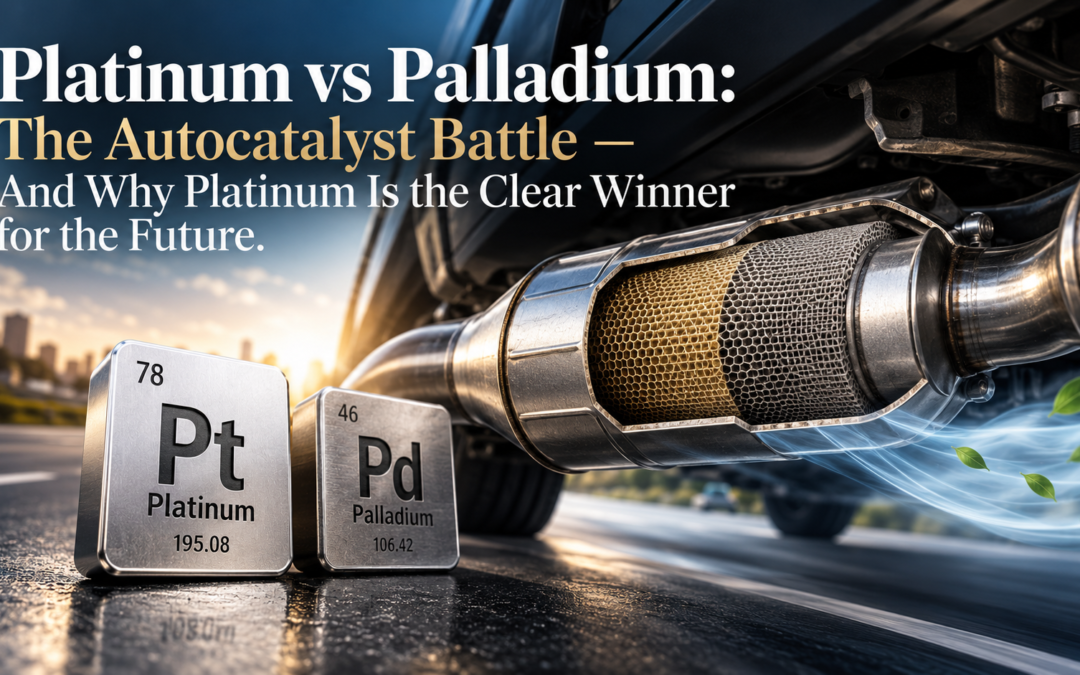
Platinum vs Palladium: The Auto-catalyst Battle — And Why Platinum Is the Clear Winner for the Future.
For more than 30 years, one of the most important industrial battles has taken place beneath every car, truck, and bus on the road.
Not in the engine.
Not in the electronics.
But inside the auto-catalyst — the device that converts toxic exhaust gases into cleaner emissions.
The two contenders have been:
- Platinum (Pt) — the noble metal known for durability, stability, and long-term performance
- Palladium (Pd) — the metal that surged in price during a period of regulatory and supply disruption
Today, the tide has turned.
Automotive engineers, metals analysts, and clean-energy strategists increasingly agree on one conclusion:
- Platinum is reclaiming its role as the superior auto-catalyst.
- Palladium’s dominance was temporary.
- The future of emissions control and clean-energy catalysis belongs to platinum.
This article explains why — and why this shift matters not only industrially, but also for investors looking at long-term metals fundamentals.
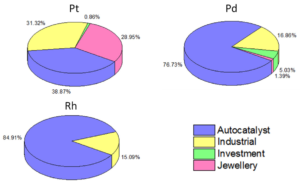
Platinum Delivers Superior Catalytic Performance
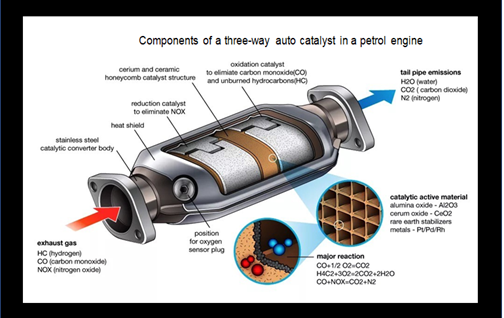
In emissions control, performance is measured by how effectively a catalyst reduces:
- carbon monoxide (CO)
- hydrocarbons (HC)
- nitrogen oxides (NOx)
Across these reactions, platinum consistently demonstrates:
- higher catalytic efficiency
- greater resistance to thermal degradation
- superior tolerance to chemical poisoning (sulfur, phosphorus, trace contaminants)
- longer operational lifespan under repeated heating cycles
Palladium works — but platinum performs better under stress.
Historically, automakers substituted palladium primarily due to cost, not performance, during periods when platinum prices were elevated. With that price relationship now reversed, manufacturers are returning to the superior material.
Platinum vs Palladium: The Auto-catalyst Battle 1
Platinum Handles Extreme Heat Far Better Than Palladium
Catalytic converters operate in punishing environments:
- 600–900°C during normal driving
- up to 1,200°C under heavy load or regeneration
Platinum remains stable at these temperatures.
Palladium tends to sinter — its particles clump together, reducing surface area and catalytic efficiency over time.
This thermal resilience is why platinum is also used in:
- aerospace applications
- turbine coatings
- high-temperature industrial processes
In some applications, a microscopic platinum layer can dramatically extend component lifespan — a property palladium cannot replicate at scale.
Platinum Works Across Petrol, Diesel, and Heavy Industry
Palladium performs best in petrol engines.
Platinum performs effectively across:
- petrol engines
- diesel engines
- heavy machinery
- mining vehicles
- marine engines
- stationary industrial generators
As emissions regulations tighten for commercial fleets, mining, and transport — particularly diesel-heavy sectors — platinum becomes the only viable long-term solution.
This is especially relevant in Australia, where diesel engines dominate mining, logistics, and heavy industry.
Palladium Supply Is Fragile — Platinum Is Tight but More Predictable
Palladium supply is highly concentrated and geopolitical exposed, with significant reliance on Russia and South Africa.
Platinum supply is also constrained, but it benefits from:
- broader industrial transparency
- established recycling streams
- clearer long-term demand signals
While South African platinum output faces challenges, those challenges paradoxically strengthen the long-term case for platinum price rebalancing rather than destabilising it.
Automakers Are Actively Substituting Palladium With Platinum
This is no longer theoretical.
Global automakers are already:
- redesigning catalyst systems
- reformulating metal loadings
- substituting platinum back into autocatalysts
Industry data suggests a meaningful portion of palladium demand has already been replaced by platinum — with more substitution expected as designs mature.
Once substitution reaches critical mass, palladium demand erosion becomes structural rather than cyclical.
Platinum Has Hydrogen Synergy — Palladium Does Not
This is the decisive advantage.
Platinum plays a central role in:
- PEM electrolysers (green hydrogen production)
- hydrogen fuel cells
- ammonia cracking
- hydrogen purification
- industrial hydrogenation
Palladium has little relevance in these systems.
As hydrogen infrastructure expands globally, platinum benefits from second-life demand beyond autocatalysts. Palladium does not.
Platinum Is Cheaper — Despite Being the Better Metal
Today’s pricing defies fundamentals.
Platinum often trades below palladium despite being:
- more durable
- more versatile
- more relevant to future energy systems
- historically priced above gold
This mismatch between utility and price rarely persists indefinitely.
Platinum Wins Across Every Critical Metric
| Metric | Platinum | Palladium | Winner |
| High-temperature stability | Excellent | Weaker | Platinum |
| Poison resistance | Strong | Lower | Platinum |
| Petrol engines | Effective | Effective | Tie |
| Diesel engines | Superior | Limited | Platinum |
| Industrial durability | Extremely high | Lower | Platinum |
| Hydrogen technology | Critical | Minimal | Platinum |
| Supply resilience | More balanced | Russia-heavy | Platinum |
| Relative value | Undervalued | Historically inflated | Platinum |
Platinum doesn’t just edge out palladium — it dominates across categories.
Ratios Reinforce Platinum’s Undervaluation
Platinum remains deeply discounted across multiple relative measures:
- Platinum–Gold
- Platinum–Silver
- Platinum–Palladium
These ratios consistently signal mispricing when viewed against supply constraints, industrial necessity, and future demand.
Physical Platinum Captures What Paper Products Cannot
ETFs and synthetic products do not benefit from:
- supply disruptions
- industrial competition for metal
- premium expansion
- refinery constraints
Physical platinum does.
When stored securely in a private, non-bank vault, investors retain:
- full legal ownership
- insurance protection
- independence from the financial system
- long-term security
Internal links:
Buy Platinum
Store Platinum
Conclusion: Palladium Had Its Moment — Platinum Owns the Future
Palladium’s rise was driven by short-term constraints and regulatory change.
Platinum’s resurgence is driven by:
- superior engineering performance
- hydrogen-energy relevance
- auto-catalyst redesign
- structural supply limits
- long-term industrial necessity
The shift is already underway.
Those who recognise it early are positioning quietly — with physical metal, not headlines.
Secure Physical Platinum at Private Vaults Australia
📞 1300 888 782
📍 Unit 3 – 73 Redcliffe Parade, Redcliffe


2 months free. No long-term commitment necessary. Limited spots available.

Recent Comments