
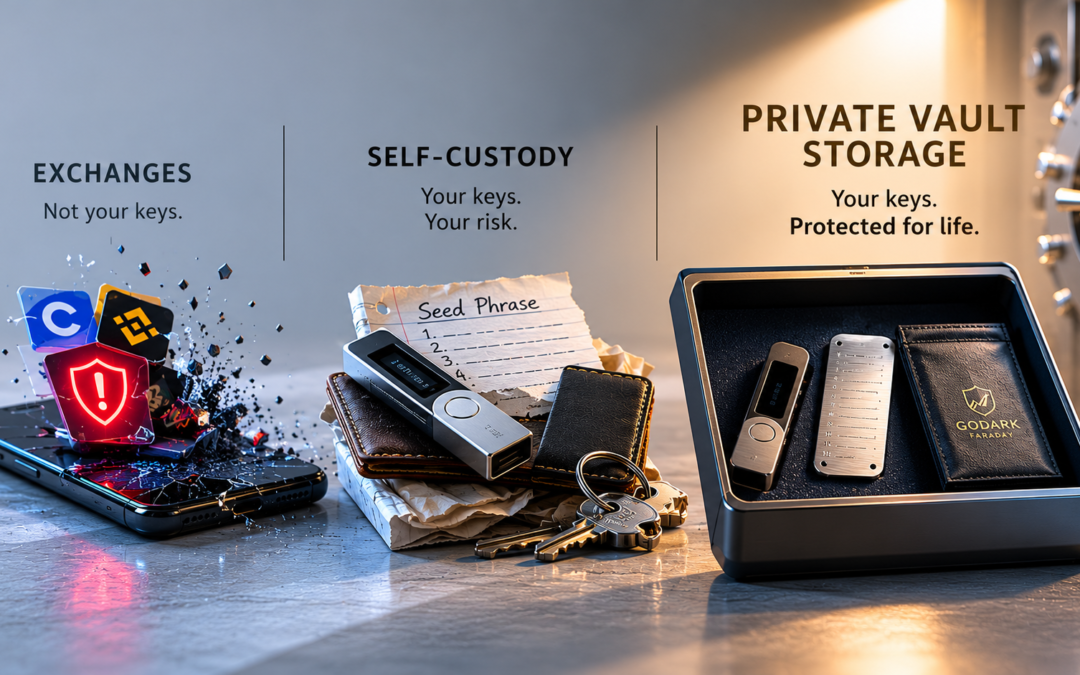
Many people don’t understand Crypto Exchange vs Self-Custody vs Private Vault Storage.
Why Serious Crypto Holders Are Moving Their Keys Offline — Permanently
For years, crypto investors were told a simple story:
“Leave your assets on an exchange — it’s easier.”
“Or self-custody at home — that’s real ownership.”
Both sound reasonable.
Both have failed investors repeatedly.
As crypto matures, one truth is becoming unavoidable:
How and where you store your private keys matters more than which coin you own.
This article breaks down the three dominant crypto storage models, the risks most people don’t fully understand, and why high-net-worth individuals, SMSF trustees, and long-term crypto holders are increasingly choosing private vault storage for their digital assets.
No hype.
No fear-mongering.
Just reality.
Crypto Exchanges: Convenience With Counterparty Risk
Crypto exchanges were never designed to be banks — yet millions of Australians treat them as if they are.
When crypto is left on an exchange:
- You do not control the private keys
- You own a claim, not the asset
- Access depends on the exchange’s solvency, compliance status, and systems
This exposes users to:
- Exchange insolvency
- Withdrawal freezes
- Regulatory intervention
- Account lockouts
- Internal fraud
- Cyber breaches
History is brutally clear:
- Mt. Gox
- FTX
- Celsius
- BlockFi
- Voyager
In every case, users believed their crypto was “safe”.
If an exchange fails, your crypto becomes part of a legal process — not an asset you can access.
Convenience is not custody.
And custody is everything.
Self-Custody at Home: Ownership With Serious Hidden Risks
After exchange failures, many crypto holders move to self-custody:
- Hardware wallets
- Seed phrases
- Paper backups
- Home safes
This does give ownership — but it introduces a different category of risk most people underestimate.
Home storage risks include:
- Theft during burglary
- Fire destroying wallets and backups
- Flood damage
- Loss of seed phrases
- Family members discarding or misplacing devices
- Insurance exclusions
- Single-point-of-failure risk
A home safe does not protect against:
- House fires reaching 1,000°C
- Flood ingress
- Targeted theft
- Insurance denial
And once a seed phrase is lost or destroyed — crypto is gone forever.
There is no recovery process.
No helpdesk.
No reset.
Digital Infrastructure Risk: The Carrington Event Problem
One risk almost no crypto holder plans for is systemic digital disruption.
The Carrington Event of 1859 was a solar storm so powerful it:
- Disabled telegraph systems worldwide
- Set equipment on fire
- Disrupted global communications
Modern equivalents would impact:
- Power grids
- Internet infrastructure
- Exchanges
- Cloud backups
- Digital wallets
- Data centres
If your crypto security relies on:
- Online access
- Power availability
- Cloud backups
…it is not resilient.
This is why offline, shielded storage is becoming essential.
The Weakest Link in Crypto Security: The Seed Phrase
Most crypto losses occur not from hacking, but from poor seed phrase protection.
Common mistakes:
- Seed phrases stored in drawers
- Photos stored on phones
- Notes in cloud apps
- USBs kept at home
- Backups stored beside the wallet
This creates a single failure point.
If someone finds the seed phrase, they own the crypto.
No password.
No reversal.
No dispute process.
Why Private Vault Storage Solves the Crypto Custody Problem
This is where private vault storage changes everything.
A private vault is not digital custody.
It is physical protection for digital access.
At Private Vaults Australia, clients store:
- Hardware wallets
- Metal seed backups
- Encrypted USBs
- Paper recovery phrases
- Offline backups
Inside:
- A UL-rated vault
- A flood-free, elevated facility
- With exclusive keyholder control
- And no staff access to contents
Your crypto keys become:
- Offline
- Unhackable
- Unfreezable
- Insulated from digital failure
This is true cold storage — without home-storage risk.
Faraday Protection: Shielding Against EM & Signal Risk
Serious crypto holders now combine vault storage with Faraday protection.
A Faraday bag or GoDark bag:
- Blocks electromagnetic signals
- Prevents remote scanning
- Shields against EMP and solar flare interference
- Stops Bluetooth, Wi-Fi, NFC leakage
At PVA, clients can:
- Store devices inside Faraday bags
- Purchase GoDark bags on-site
- Combine physical and electromagnetic isolation
This creates air-gapped, shielded custody — the highest standard available.
Why High-Net-Worth Crypto Holders Are Leaving Home Storage
HNWs, SMSFs, and long-term holders understand one thing:
Crypto is only valuable if access survives every scenario.
Private vault storage protects against:
- Burglary
- Fire
- Flood
- Digital outages
- Exchange failure
- Government overreach
- Cyber attacks
- Infrastructure collapse
It removes:
- Single-point-of-failure risk
- Emotional storage decisions
- Insurance gaps
- Family exposure
Crypto becomes:
- Structured
- Documented
- Recoverable
- Estate-safe
- Inheritable
Crypto Custody for SMSFs & Long-Term Planning
For SMSF trustees, storage must be:
- Independent
- Secure
- Auditable
- Free from personal-use risk
Private vault storage supports:
- Clear separation
- Offline custody
- Proper documentation
- Long-term asset preservation
This is why SMSF crypto strategies increasingly combine:
- Self-custody
- Private vault storage
- Physical documentation
Conclusion: Crypto Isn’t Digital — Access Is
Crypto itself is decentralised.
Access is not.
Your access depends entirely on:
- Where your keys are stored
- How they are protected
- Who controls physical access
Exchanges trade convenience for risk.
Home storage trades ownership for fragility.
Private vault storage trades convenience for permanence.
For serious crypto holders, that trade-off is obvious.
Protect Your Crypto the Way Serious Investors Do
📞 1300 888 782
🔐 Store your crypto keys offline, shielded, and independent of the banking system
📍 Unit 3 – 73 Redcliffe Parade, Redcliffe


2 months free. No long-term commitment necessary. Limited spots available.

Recent Comments