

A Calm, Fact-Based Guide Every Saver Should Understand about the bank bail-in law**
Most Australians assume that the money they deposit in a bank is simply “theirs.”
The truth is more complex.
In February 2018, Australia quietly passed legislation enabling the use of bail-ins — a mechanism already used in parts of Europe — allowing certain types of bank liabilities to be restructured or converted to support a failing bank.
While bail-ins are typically framed as a tool for protecting the broader financial system, very few Australians understand how the law actually works, what types of assets may be exposed, or how to protect the parts of their wealth that should never sit inside a banking system during a crisis.
This guide explains the realities calmly, factually, and clearly — so Australians can make informed decisions without fear, speculation, or confusion.
What Is a Bank Bail-In? (Simple Explanation)
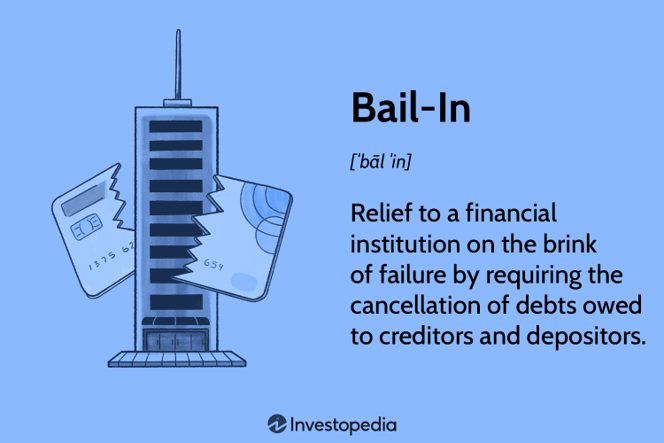
A bail-out uses government money (taxpayer funds) to rescue a failing bank.
A bail-in, by contrast, uses the bank’s own resources — including certain customer-held liabilities — to stabilise the institution internally.
This may include:
- specific classes of unsecured debt
- hybrid securities
- convertible instruments
- and in some jurisdictions: deposit liabilities
The exact application depends on a country’s legislation.
In Australia, the 2018 amendments to the Banking Act introduced a framework allowing APRA to direct a failing institution to recapitalise by converting or writing down certain liabilities.
The law does not explicitly list deposits as bail-in instruments — but it also does not exempt them.
This ambiguity is the primary concern for many Australians.
Why Bail-Ins Exist: The Global Context
Since 2008, international regulators have moved toward bail-ins for three reasons:
✔ To prevent taxpayer-funded bailouts
✔ To ensure banks hold sufficient loss-absorbing resources
✔ To stabilise financial markets quickly during failure events
This shift is not unique to Australia.
It is part of a broader global banking architecture.
But here’s the key:
Depositors must understand that bail-in laws change the relationship between banks and the funds you hold inside them.
Again — this is not alarmist.
This is the legislative reality.
The Australian Bail-In Debate: Why Depositors Are Concerned
Two facts create ongoing public uncertainty:
FACT 1 — Australia’s bail-in law powers are written broadly
The Banking Act amendments give APRA wide discretion to convert or write down “any other instrument” if needed to ensure viability.
Deposits are not specifically excluded.
FACT 2 — Depositors are unsecured bank creditors
Under the law, a deposit is:
a liability owed to you by the bank — not a piece of property you own.
This is not opinion.
This is legal structure.
Your deposit is on the bank’s balance sheet as:
- their liability
- your claim against the bank
If a bank were ever placed into resolution, depositors are part of the creditor hierarchy.
This is why many Australians are beginning to ask:
“What portion of my savings should really live inside a bank?”
Not to withdraw everything —
but to diversify wisely.
The FCS Is Not a Perfect Safety Net (Short Recap)
- The Financial Claims Scheme (FCS) is not automatic
- It must be activated by the Treasurer
- It is capped at $20B per institution
- Total system capacity is $80B
- Australian deposits exceed $3 trillion
- The scheme is not prefunded
These realities mean:
Deposits are safe — until systemic stress exceeds the scheme’s capacity.
This is not criticism.
It is simple scale mathematics.
What Cannot Be “Bail-In’d”: Property You Actually Own
This is the key distinction.
Bail-in law applies to liabilities — not assets you physically own and store independently.
Examples of what cannot be bail-in’d:
✔ Physical gold
✔ Physical silver
✔ Physical platinum
✔ Jewellery
✔ Cash held physically
✔ Documents, wills, deeds
✔ Data backups
✔ Crypto hardware wallets
✔ Any tangible asset stored outside the banking system
These items are your property, not the bank’s liability.
They do not sit on a bank’s balance sheet.
They cannot be:
- converted
- written down
- seized
- frozen
- or reclassified
They remain wholly under your control.
Why a Private Vault (Not a Bank Vault) Is the Correct Protection Strategy
A common misconception is:
“I’ll keep valuables in my bank’s safe deposit box — that’s outside the system.”
Unfortunately, that is incorrect.
Bank vault lockers sit inside the banking system and may be impacted by:
- branch closures
- liquidation processes
- access freezes
- system outages
- administrative control by the statutory manager
Furthermore:
❌ Banks can restrict access during resolution
❌ Bank vault contents are not insured
❌ Bank vaults are not +cannot be+ accessed when branches close
❌ Bank vaults are not independent of APRA actions
This is why many Australians — especially SMSFs and retirees — are moving to private safe deposit lockers.
A private vault like PVA offers:
✔ non-bank custody
✔ independence from APRA resolution processes
✔ exclusive keyholder control
✔ no staff access
✔ flood-free engineering
✔ insurance
✔ privacy protection
✔ no reliance on the FCS
✔ no link to bank liabilities
Your assets remain yours.
Full stop.
Why Many Australians Maintain 10–12 Weeks of Living Costs Outside the System
This is not a recommendation — it is a common-sense risk management practice used worldwide.
If you need $1,000 per week to live, keeping $10,000–$12,000 in emergency funds physically secured offers:
- continuity during outages
- certainty during cyber events
- liquidity during bank freezes
- independence during system stress
Stored safely in a private safe deposit locker, this emergency buffer is:
- protected
- unhackable
- unfreezable
- yours under all scenarios
Again — this is not about predicting crisis.
It is about resilience.
Should Australians Be Afraid of Bail-Ins? No. But They Should Be Informed.
Australia’s banking system is strong.
But understanding the difference between:
- a bank deposit (a liability), and
- a physical asset you own
…helps Australians build smarter, more robust wealth strategies.
We do not fear house fires — but we buy insurance.
We do not fear storms — but we keep emergency supplies.
We do not fear the banking system — but we diversify our wealth across systems with different risk profiles.
This is intelligent, not emotional.
Conclusion: The Best Protection Is Ownership, Not Assumptions
The Bank Bail-In Law is not a prediction of crisis —
it is simply part of Australia’s regulatory toolkit.
But the fact remains:
✔ Deposits inside banks = bank liabilities
✔ Assets stored privately = your property
Physical ownership — bullion, jewellery, cash reserves, documents — stored independently in a private vault gives Australians:
- certainty
- continuity
- privacy
- control
- and genuine peace of mind
A private vault does not replace banks.
It complements them.
It creates resilience — the kind every family, SMSF and business deserves.
📞 1300 888 782
🔐 Protect What You Own — Outside the Banking System
Store bullion, jewellery, documents and emergency reserves in Brisbane’s only flood-free, private vault with exclusive keyholder control.
Unit 3 – 73 Redcliffe Parade, Redcliffe


2 months free. No long-term commitment necessary. Limited spots available.

Recent Comments