
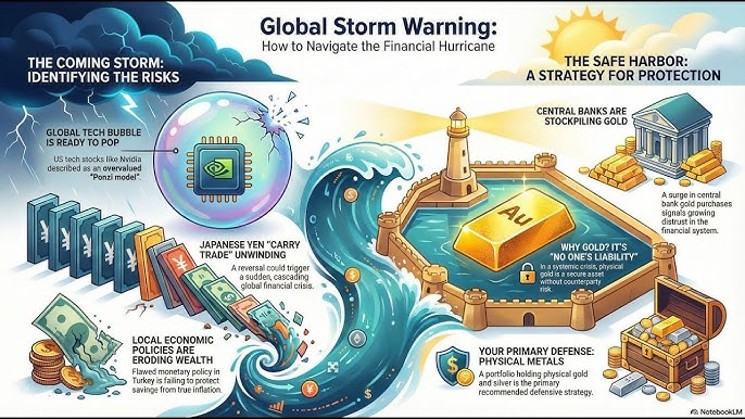
How Modern Financial System Risk Threatens Your Wealth — And The Assets That Survive Every Crisis**
Most Australians believe risk comes from the stock market, property downturns, interest rates, “the economy”…
But the most dangerous risks to wealth are not the ones you see coming.
They are the quiet risks.
The unspoken risks.
The structural risks built into the financial system itself.
Risks you are never warned about.
Risks that SMSF trustees, wealthy investors and business owners must understand if they want their wealth to survive the next decade.
This article exposes the five hidden threats inside modern financial systems — and reveals the small group of assets that have survived:
- wars
- inflation waves
- credit crises
- sovereign defaults
- systemic banking failures
- currency collapses
- market wipeouts
…for thousands of years.
Let’s begin.
Hidden Risk #1 — Your Wealth Is Digitally Dependent (and Vulnerable)
Most wealth today exists only as:
- digits
- database entries
- electronic claims
- cloud records
- ledger balances
That means your wealth relies on:
- electricity
- banking networks
- data integrity
- cybersecurity
- regulatory discretion
- authorised institution solvency
If any of those fail — so does your access.
During outages or breaches, regulators routinely freeze:
- withdrawals
- transfers
- large payments
- international transactions
Recent cyber incidents in Australia demonstrate that digital infrastructure is not invincible.
As macro analyst Luke Gromen emphasises:
“Digital wealth is fragile. Physical wealth is not.”
This is why wealthy investors diversify into assets that exist outside the digital grid.
Hidden Risk #2 — Your Bank Balance Is Not “Your Money”
This shocks most Australians:
When you deposit money into a bank, you become an unsecured creditor of that bank.
Your deposit is:
- not segregated
- not backed by physical cash
- not held in your name
- not a vault box
- legally part of the bank’s balance sheet
Meaning:
If the bank fails, you stand in line with other creditors.
The RBA has openly stated that banks operate on fractional reserves.
They do not hold your money.
They hold a promise.
And promises fail in crises.
GoldFix summarises it brutally:
“Your bank balance is someone else’s liability. Your bullion is not.”
Hidden Risk #3 — Inflation Steals More Wealth Than Any Crash
Most investors fear crashes.
But crashes are temporary.
Inflation?
Inflation is permanent.
The Australian Bureau of Statistics (ABS) shows that prices have risen every decade without exception.
High inflation:
- destroys cash
- erodes purchasing power
- reduces retirement value
- crushes fixed income
- inflates maintenance and insurance costs
- weakens the Australian dollar
This is the great “silent wealth killer.”
SMSFs — with 20, 30, 40-year planning horizons — face the most severe consequences.
Hidden Risk #4 — Counterparty Failure (The One Risk Investors Always Forget)
Every modern asset except physical metals carries counterparty risk:
- shares rely on corporate solvency
- bonds rely on government solvency
- property relies on tenants, loans, banks, insurance
- digital assets rely on exchanges and networks
- cash relies on banks
- ETFs rely on custodians
- managed funds rely on administrators
- derivatives rely on liquidity
If one link breaks in the chain, you lose access — or value.
Doug Casey explains it simply:
“If someone else must make good on a promise for your asset to hold value, you do not truly own it.”
This truth becomes painfully obvious during crises.
This is why wealthy families and SMSFs hold no-counterparty assets in private custody.
Internal link:
PVA Private Vaulting (https://privatevaults.com.au/safe-deposit-boxes/)
Hidden Risk #5 — Government & Regulators Can Change the Rules Overnight
History shows that governments facing fiscal pressure often resort to:
- capital controls
- bank withdrawal limits
- superannuation rule changes
- wealth taxes
- transaction monitoring
- currency debasement
- emergency legislation
- bail-in mechanisms
The Banking Act amendments in 2018 introduced language that enables certain bail-in scenarios.
The Financial Claims Scheme (FCS) covers only $250,000 per authorised institution — and only after a waiting period.
(Many SMSFs exceed this in cash.)
The higher your balance, the higher your systemic exposure.
Wealthy Australians know this.
SMSFs know this.
They are quietly repositioning their portfolios toward independent assets outside regulatory choke points.
SO… What Assets Actually Survive Every Crisis?
Despite:
- bank failures
- inflation
- sovereign defaults
- market collapses
- geopolitical shocks
- currency resets
- liquidity freezes
…one category has survived every financial catastrophe in recorded history:
Physical precious metals — gold, silver and platinum.
Not ETFs.
Not digital gold.
Not synthetic exposure.
Not “gold accounts.”
Only physical, allocated, unencumbered metals stored independently.
Gold does not depend on:
- banks
- electricity
- liquidity
- custodians
- counterparties
- promises
- financial markets
- government guarantees
Gold simply exists.
As it has for over 5,000 years.
Silver and platinum have also retained value across:
- currency transitions
- global wars
- industrial revolutions
- systemic crises
They are universal, recognised, liquid, private, and indestructible.
Why Metals Must Be Stored Privately — Not in Banks
Bank vaults share the same systemic risk as the banking system itself.
During failures:
- branches close
- vault access freezes
- regulators control access
- contents may be inaccessible for months
Private Vaults Australia solves this with:
✔ Exclusive client key control
✔ Non-bank independence
✔ No staff access to contents
✔ Structured audit documentation for SMSFs
✔ Flood-free, purpose-built vault
✔ $20,000 complimentary insurance
✔ Seamless chain from GBA purchase to PVA storage
This is sovereign wealth protection — not the illusion of safety offered by banks.
The Core Truth: Modern Financial Systems Reward Compliance — Not Safety
Where the average investor places trust in:
- institutions
- markets
- digital systems
The wise investor places trust in:
- ownership
- privacy
- independence
- tangible value
- wealth insulation
SMSFs and wealthy individuals are increasingly adopting a dual-structure wealth model:
- Mainstream assets (shares, property, managed super)
- Private, independent hard assets (precious metals stored in a private vault)
This is not fear.
It is prudence.
It is not speculation.
It is protection.
It is not pessimism.
It is clarity.
Conclusion: You Can’t Control the System — but You CAN Control What You Store Outside It
The global financial system is becoming:
- more leveraged
- more regulated
- more digital
- more fragile
- more interconnected
This creates risk — not by accident, but by design.
SMSFs and wealthy Australians do not want to depend on:
- bail-ins
- fragile banks
- volatile currencies
- shifting legislation
- complex intermediaries
They want sovereignty.
Gold.
Silver.
Platinum.
Stored privately at PVA.
This is how wealth survives any crisis.
This is how wealth passes safely across generations.
This is how financial independence becomes real, not theoretical. So protect yourself from Modern Financial System Risk today.
📞 1300 888 782
📍 Unit 3 – 73 Redcliffe Parade, Redcliffe
Buy Physical Bullion (GBA)
Store Independently (PVA)


2 months free. No long-term commitment necessary. Limited spots available.
