

With financial uncertainty constantly looming over global economies, rising government debt and the cost of living putting pressure on households around the world, it’s natural to ask:
Why can’t governments simply print more money to solve economic problems?
If a government needs more money to pay its debts, fund infrastructure, support households or stimulate the economy, it might seem like an obvious solution.
Just create more.
Unfortunately, economics doesn’t work quite that way.
Governments can create more currency, but they cannot simply create more wealth.
When the supply of money increases significantly without a corresponding increase in the goods and services available in an economy, the purchasing power of that currency can come under pressure.
Over time, this can contribute to inflation and currency depreciation, meaning the money you’ve worked hard to save may buy less than it once did.
This is one of the reasons investors around the world consider assets such as gold and other precious metals when thinking about long-term wealth preservation.
Printing More Money Does Not Create More Wealth
The simplest answer to the question of why governments can’t just print more money is this:
Printing money creates more currency, not more wealth.
Money is a medium of exchange. It allows us to buy and sell goods and services and provides a way of measuring value.
But imagine an economy with 1,000 houses and $1 million circulating among its population.
If the amount of money suddenly increased to $2 million while the number of houses remained exactly the same, the country wouldn’t suddenly have twice as many houses.
There would simply be more money competing for the same limited supply.
The same principle applies to food, energy, raw materials, labour and countless other goods and services.
When demand increases faster than supply, businesses can raise prices.
And when prices rise, the purchasing power of your money falls.
How Does This Devalue Your Money?
Inflation doesn’t necessarily make the number in your bank account go down.
If you have $100, you may still have $100.
The problem is that the $100 may no longer buy as much as it used to.
Think about the everyday things you buy.
Groceries.
Fuel.
Rent.
Insurance.
Building materials.
Electricity.
Services.
If the prices of these things rise over time while your savings remain unchanged, your purchasing power has effectively declined.
This is why inflation can be particularly damaging to people who hold large amounts of cash for long periods.
Even relatively modest inflation can have a substantial cumulative effect over decades.
The Silent Erosion of Purchasing Power
Consider someone who has $100,000 sitting in cash.
The balance still says $100,000 ten years later.
But if prices have risen significantly during that period, the amount of goods and services that $100,000 can purchase may be considerably lower.
The dollars haven’t disappeared.
Their purchasing power has.
This is one reason why simply measuring wealth by the number of dollars you have can be misleading.
The more important question is:
What will those dollars actually be worth in terms of what they can buy?
Can Printing Too Much Money Cause Hyperinflation?
It is important to distinguish between ordinary inflation and hyperinflation.
Inflation is a normal feature of many modern economies and is influenced by numerous factors, including demand, supply constraints, energy prices, wages, government spending and monetary policy.
Hyperinflation is something much more extreme.
It occurs when prices rise at extraordinarily rapid rates and confidence in a currency can collapse.
History has shown what can happen when severe economic problems combine with excessive monetary expansion and a loss of confidence in the currency.
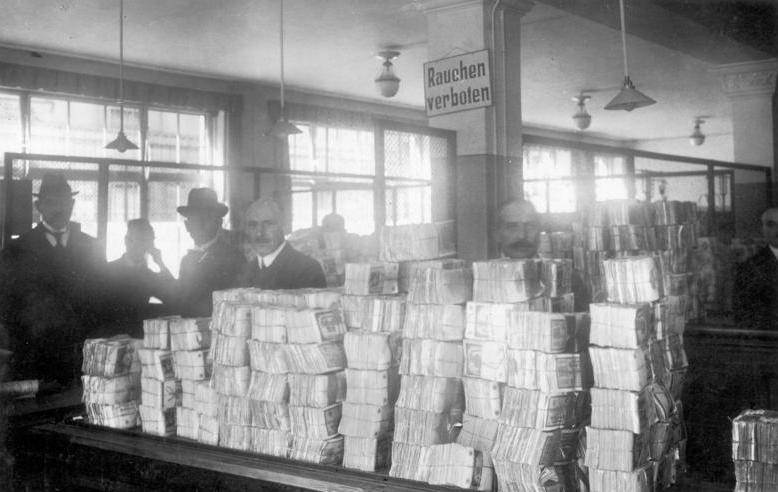
Germany’s Hyperinflation
One of the most famous examples occurred in Germany during the early 1920s.
Following World War I, Germany was dealing with enormous economic and fiscal pressures, including war reparations and government deficits.
The government increasingly relied on the creation of money to meet its financial obligations.
As economic conditions deteriorated and confidence in the German mark collapsed, inflation accelerated dramatically.
By 1923, prices were rising at extraordinary rates.
The German mark became almost worthless, with people requiring enormous quantities of banknotes to purchase everyday goods.
The images of people carrying wheelbarrows filled with money have become an enduring symbol of hyperinflation.
The German experience wasn’t simply a case of “printing money equals hyperinflation”. A combination of economic disruption, fiscal problems, monetary expansion and collapsing confidence contributed to the crisis.
But it provides a powerful historical reminder:
A currency is only useful as long as people retain confidence in its value.
Zimbabwe’s Hyperinflation
Zimbabwe provides a more recent example.
During the 2000s, Zimbabwe experienced severe economic disruption, declining agricultural production, government financial problems and rapidly increasing inflation.
The situation eventually developed into one of the most extreme episodes of hyperinflation in modern history.
By 2008, prices were increasing at extraordinary rates and the Zimbabwean dollar had lost much of its purchasing power.
The government eventually abandoned the currency in favour of foreign currencies, particularly the US dollar, for many domestic transactions.
Again, the causes were complex and extended beyond simply increasing the money supply.
But the result demonstrated just how quickly confidence in a currency can disappear when an economy experiences extreme instability.
What Can We Learn From History?
Australians aren’t expecting the Australian dollar to suddenly become worthless.
And there is no reason to assume that Australia is heading towards a repeat of Germany in 1923 or Zimbabwe in 2008.
The lesson is much simpler.
Currencies can lose purchasing power.
It can happen slowly through ordinary inflation or much more dramatically during periods of severe economic instability.
Either way, people who have spent decades accumulating wealth have a legitimate reason to think about how they can preserve that wealth.
Protecting Yourself From Currency Devaluation
There is no magic investment that is guaranteed to protect your wealth from every economic environment.
Different assets perform differently depending on inflation, interest rates, economic growth, market conditions and investor sentiment.
This is why diversification is so important.
Investors may consider a combination of assets such as property, shares, bonds, cash, commodities and precious metals.
Among these, gold has a particularly long history as a store of value.
Gold has been used as money and a form of wealth for thousands of years.
Unlike fiat currency, governments cannot simply create unlimited quantities of physical gold whenever they need additional funds.
The global supply of gold increases gradually through mining and recycling.
This scarcity is one of the reasons gold continues to attract investors and central banks around the world.
Why Gold?
Gold isn’t a magic solution to inflation.
Its price can fall, sometimes substantially, and there are periods when other investments outperform it.
But gold has some characteristics that make it fundamentally different from fiat currency.
It is:
- A tangible physical asset
- Globally recognised
- Limited in supply
- Not issued by a government
- Not dependent on a company’s ability to repay a debt
- Historically used as a store of value
- Easily divisible and transferable
For investors concerned about inflation, currency depreciation or broader financial uncertainty, these characteristics can make physical gold an attractive component of a diversified wealth-preservation strategy.
What About Silver and Platinum?
Gold isn’t the only precious metal worth considering.
Silver has both monetary and industrial uses and is widely held by investors as a precious-metal asset.
Platinum is another scarce precious metal with significant industrial applications as well as investment demand.
Each metal has its own characteristics and risks, and their prices can behave very differently.
For investors who choose to hold physical precious metals, the important consideration is not simply which metal they own.
It’s also where they keep it.
The Problem With Keeping Valuable Assets at Home
Owning physical precious metals gives you direct ownership of a tangible asset.
But it also creates a practical question:
Where are you going to store it?
Keeping a few coins at home may seem straightforward.
But what happens when your holdings grow?
A gold and silver collection worth $5,000 is one thing.
A collection worth $50,000, $100,000 or more is another.
Keeping substantial amounts of valuable assets at home can make you a more attractive target for thieves and creates additional concerns around fire, natural disasters and other risks.
A domestic safe can certainly provide an additional layer of protection, but it doesn’t change the fact that the assets are still located inside your home.
For people who hold significant amounts of physical wealth, specialist off-site storage can make sense.
Store Your Wealth Somewhere Designed to Protect It
If you’re going to go to the trouble of investing in physical gold, silver or other valuable assets, it makes sense to think carefully about how those assets will be protected.
This is where a private vault can provide an important advantage.
At Private Vaults Australia, we provide secure storage specifically designed for valuable possessions.
Our Redcliffe facility allows customers to store their:
- Gold and silver bullion
- Platinum
- Jewellery
- Watches
- Rare coins and collectables
- Important documents
- Family heirlooms
- Other valuable possessions
in a dedicated high-security environment away from their homes.
Insurance Included With Your Safety Deposit Box
Security is only part of protecting valuable assets.
Insurance is another important consideration.
Every safety deposit box at Private Vaults Australia includes $20,000 of complimentary insurance.
For customers whose valuables are worth more than $20,000, additional insurance can be arranged at very competitive rates, made possible by the high-security environment in which the valuables are stored.
This provides an attractive alternative to simply keeping large amounts of valuable property at home and arranging additional insurance through your household policy.
Depending on your individual circumstances, moving valuable possessions away from your home may also mean that you no longer need to insure those items under your home contents insurance.
This can potentially reduce the value of the possessions you’re paying to insure at home and may therefore reduce your home insurance premium.
Always speak with your insurer before changing your policy, as the impact will depend on your individual circumstances and policy terms.
Your Wealth Doesn’t Have to Be in One Place
When most people think about diversification, they think about investments.
Shares.
Property.
Cash.
Bonds.
Precious metals.
But there is another type of diversification worth considering:
Diversifying where your valuable assets are stored.
Keeping all your valuable possessions in one residential property means that a single event could potentially affect a significant portion of your physical wealth.
Storing some of those assets securely away from your home provides another layer of protection.
This doesn’t mean you need to put everything into a vault.
It simply means thinking carefully about what you own, how much it is worth and whether keeping all of it at home makes sense.
Protecting Wealth Is About More Than Making Money
Building wealth is only one part of the equation.
Protecting the wealth you’ve already accumulated is just as important.
Inflation can gradually reduce the purchasing power of cash.
Market volatility can affect investments.
Economic uncertainty can change the value of assets.
And physical possessions kept at home can be exposed to theft and other risks.
No investment or storage solution can eliminate every risk.
But understanding those risks and taking steps to manage them can make your overall financial position more resilient.
For some investors, precious metals form part of that strategy.
And for those who choose to own physical precious metals, secure storage should be part of the plan from the beginning.
Final Thoughts
So, why can’t governments simply print more money to solve economic problems?
Because money isn’t wealth.
Creating additional currency doesn’t automatically create more houses, food, energy, businesses, infrastructure or other productive assets.
When the supply of money grows faster than the supply of goods and services, inflation can occur and the purchasing power of the currency can decline.
History has demonstrated how extreme this can become when economic problems, monetary expansion and collapsing confidence combine.
You don’t need to expect hyperinflation to be concerned about inflation, however.
Even a gradual decline in purchasing power can have a meaningful effect on long-term savings and accumulated wealth.
This is why many investors choose to diversify across different types of assets, including tangible assets such as gold and other precious metals.
And if you choose to hold physical wealth, don’t overlook the importance of protecting it.
Secure Your Precious Metals With Private Vaults Australia
Private Vaults Australia provides secure, private storage for gold, silver, platinum, jewellery, watches, documents and other valuable possessions.
Our purpose-built Redcliffe facility provides a secure alternative to keeping significant amounts of valuable property at home.
Every safety deposit box includes $20,000 of complimentary insurance, with additional cover available at competitive rates for customers who require it.
If you’ve accumulated valuable assets and want to know more about protecting them, contact Private Vaults Australia or arrange a private tour of our facility.
This article is provided for general information only and does not constitute financial advice. Precious metals and other investments can rise and fall in value. You should conduct your own research and consider seeking independent financial advice before making investment decisions.


2 months free. No long-term commitment necessary. Limited spots available.

Recent Comments